The last Thursday of our discussion section was very nice. I got to sing my song for the class. I was running late that day, so I ended up parking in the 20 minute stalls with my hazards blinking. I returned to my car at the conclusion of class to find my battery dead.
I called my mother-in-law to see if she was around to deliver me a jump. I decided it would be a good time for an observation! This time around the UWSP campus was covered with snow. I swear for the first four years of my schooling this place was nothing but snow. It certainly doesn't seem that way now.
It was a very clear day. The weather was hovering around 32 degrees. It felt warmer. The day was just great! I would go disc golfing this day as well. I like the little snowman built on top of this hill.
The dog sitting in snow. I guess this statue isn't so bad after all.
After listening to the UWSP Sustainability Coordinator, I think our University pays a lot of lip service to sustainability, but the reality is we really just don't do enough. The University needs to think about really expanding their use of technologies that are going to save energy and produce it as well. Our University could offset much of it's coal and natural gas use by simply putting solar panels on a lot of the buildings. The NFAC uses so much electricity! Theaters use a ridiculous amount. I think PV panels would help immensely!
It was November 15th that the majority of our NRES 370 Class went out with Glen Reindl's Wisconsin River Academy to the back of Standing Rocks Park. We showed up early, So I played frisbee with my colleagues while we waited for the bus from SPASH to show up.
The weather was a beautiful 50 degrees or so. It was very sunny. The surroundings were beautiful. Wisconsin forests are awesome!
The ranger met up with us soon after we got there. When the bus arrived Glen gave us the low down and then gave the students a similar low down. They have been out here before. We haven't
We were going after Autumn Olive, an invasive species that lives around the woods behind and in Standing Rocks Park. Basically we were charged with leading student groups in cutting down and destroying the plant. This involved one person sawing or snipping the plant and a designated herbicide sprayer This Herbicide was a mix of a potent poison and diesel fuel. The diesel was supposed to allow for a quicker destruction of the Autumn Olive and (oddly enough) so that it wouldn't spread to other plants. Apparently, the diesel doesn't wash away as easily
My group was really productive and filled with really nice kids. Some of them were hunters and pointed out deer rubs and other fun tracking signs. We worked for about 3 hours sawing and snipping. I had some gloves with me, so I ran the spray bottle while the students cut down the Autumn Olive.
I noticed the ranger had a contraption on his back that basically showered the plant with the herbicide mix. I thought this was odd as we were making the students cut them. This is supposed to lower the environmental impact. Yet, the ranger had no problem just spraying plants all over the place. I wonder what the over all effects of the spray compared to the Autumn Olive itself? Is it really worth spraying so much? Though I must say, I would hate to chop and spray all by myself.
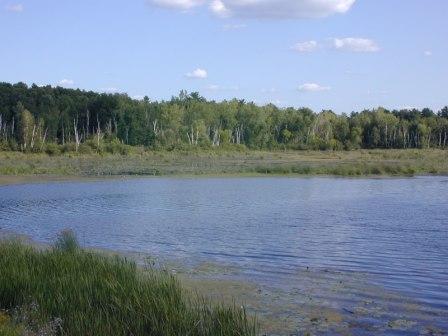
This was a beautiful pond/lake we found over a ridge. This is technically private land. The own has chosen to selectively cut his land to promote the growing of some plants/tress. I don't really know the benefit of it other than the revenue from selling the wood. Seems counter-intuitive. I guess it might be similar to control burning certain areas.
Just a quick post here. I was hanging out on Campus before Thanksgiving. This dog has always bothered me for some reason, but today it looks cool. It's overcast outside and it feels a little colder. Just a high of 35 today. There was a slight flurry last night and during the day today. It is certainly starting to feel more like a Wisconsin autumn. Not a lot of snow. Not a lot of anything percipitation-wise. Hopefully we'll get some more.
Look at this huge bug I found on the ground!!! This is crazy looking. I don't even know what kind of bug it is. It was very large...
On a fairly warm and sunny afternoon, I took a trip out to Mead Park in Stevens Point. Mead Park is across the bridge going west over the Wisconsin River. Along with a disc golf park, there is a baseball diamond, basket ball hoops, and a fully functional handicap playground. Good fishing can be found on the river during the spring and summer.
A nice shot of the river and a basket ball net. The scenery is very picturesque. The temperature was about 55 with trees that were just in the middle of turning over for Autumn.
This shot was taken looking across the river on the 8th hole towards town. That little spike is actually the clocktower to St. Peter's Catholic Church. The who course is filled with visas like this. On the summer you can find boats zooming up and down by the bridge.
Another beautiful view.
This course isn't very difficult, but it has some tricky shots that can test your throw. The course is 9 holes. It makes a great stop for lunch.
There is a beach past these trees. In the Spring and Fall, there are a lot of geese on these flatlands. It can be hazardous picking up discs, especially if you land in poop. This waste also has a lot of nasty bacteria. Ducks are also common around the area.
Thanksgiving was a really relaxing time. My wife and I went to visit her 100-year old grandmother in Park Falls, Wisconsin. I love it in Northern Wisconsin. I spent a lot of summers as a child in Minocqua. The lakes and forests can't be beat.
I worry though. Development in Northern Wisconsin due to tourism seems unstoppable. Some of my favorite places are gone or developed. Even the owners of our rented cabin are gone and their house torn down. Things change...
The food was great. The night of Thanksgiving, my wife's family and I were playing card games. I wanted to go outside for a quick moment. It was about twenty five degrees outside and snowing quite heavily. It was the first good snow of the northwoods! The morning was even more beautiful. I love the trees with snow on them.
I think what it must have been like when grandma Rose was a child. How has the environment changed? How can we do something to positively impact it? I guess I'll just have to EARN a million dollars or something.
This summer, my Wife and I took a trip with her parents across the United States. As musicians for a wedding in Utah, we decided that a family driving trip across the country would be a somewhat cost and fun way to travel. I actually have never been west of Minneapolis/Davenport. As we were driving west on I-80, the rolling hills of Iowa greeted us with an enjoyable site.
This picture was taken on a long stretch of road outside Davenport. I thought the contrast was so very interesting.
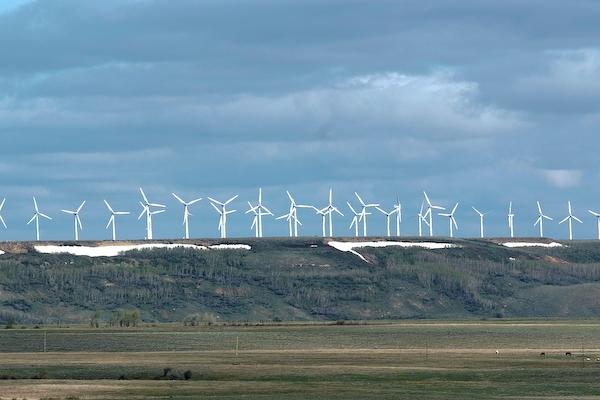
Wind energy has taken hold as a growing resource for cities and towns that have ample air flow for much of the year. This form of technology is a great example of progress towards a more sustainable future.
The report finds that in 2011, roughly 6,800 megawatts (MW) of new wind
power capacity was added to the U.S. grid, a 31 percent increase from
2010 installations. The United States’ wind power capacity reached
47,000 MW by the end of 2011 and has since grown to 50,000 MW, enough
electricity to power 13 million homes annually or as many as in Nevada,
Colorado, Wisconsin, Virginia, Alabama, and Connecticut combined. The
country’s cumulative installed wind energy capacity grew 16 percent from
2010, and has increased more than18-fold since 2000. The report also
finds that six states now meet more than 10 percent of their total
electricity needs with wind power.
This is really good news! However, an article from Minnesota Public Radio written by Rob Reimer has this to say:
Rural dwellers are "asked" to host wind turbines and to pay for transmission lines to furnish city dwellers with green power from wind. Investors make huge profits while taxpayers and ratepayers get to pay 20 percent more for their power. So who is this technology benefiting? For exactly whom is it "free?" Financially, wind energy is a losing proposition for most everyone who does not directly profit from the manufacture, siting, servicing, removal, financing or taxing of turbines, or from the disbursal of the electricity produced by them.
The wind boon benefits the turbine industry, not the general public. The industry is a terrible waste of resources: Human, physical, financial, temporal and aesthetic. These finite resources could be better spent transforming the physical infrastructure of our society toward sustainable energy production and use, and toward creating jobs that benefit the entire society.
This brings up a tremendously good point. Though Wind turbines might be seen as a sustainable method of energy, the amount of work and capital that goes into making a turbine part of the electrical grid can sometimes do more harm than good. Also, storage for all that energy is at a premium. Something has to be done to help make the sustainable energy market perform on the economic scale.
Luckily,
So now we start to understand all the moving pieces in the puzzle. Energy is an important aspect of our society, but how can we create the infrastructure that is needed to produce enough of that energy while sustaining the planet? I think wind energy will prove very useful for communities who live in rural and suburban areas that have access to open fields and windy days. However, each region is slightly different. What might work in Illinois is not going to work for Colorado. Arizona has a much greater potential for Photovoltaics while areas on the West Coast might benefit from a Geothermal plant or ten. As a nation, we need to start developing these technologies to help all of us save our planet while preserving our energy.
This fall I had the pleasure to join a few friends of mine on a wonderful trip through the Schmec kle reserve near UWSP's campus. If someone has not been there, I will gladly take them.
Schmeeckle has been a staple of campus since I first became a student. This history of the reserve is very interesting. Like most of Wisconsin in the 50's, the land was used for farming. Turns out the topsoil couldn't handle the crops, so farmers just sort of deserted it. The University bought up some land in the 60's and then by 1974 the land was proposed for a reclamation project.
It has been a stunning success. With the help of Sentry Insurance (this might be the only time I would say they helped), Lake Joanis was created and the Schmeeckle wildlife refuge was born! As a student, I spent a lot of time by Lake Joanis. I remember great days swimming in the lake, walking on the ice to the island, climbing to the tree house, and seeing so much wildlife. It creates a wonderful buffer between the campus and the Sentry building/golf course. After working at the golf course for so long, you forget the majesty that is the forest in between.
Lately, the area has been hit by drought. The new Moses Creek revitalization project, though looks wonderful, is horribly dry. There are many spots along the way that are just barren where months ago there was water.
It's funny. In 2008, we have the worst collapse of the economy since 1929. In 2012, we have the worst drought since 1934. The main problem with this comparison is that it is leading towards something that isn't good. In fact, all around the world the tension can be felt. Whether it's worrying about feeding the hungry, trying to reverse the adverse impacts of climate change, or simply trying to stop the bloodshed of war, humanity isn't doing so hot. Actually, we're plenty hot enough as it is.
I will continually do my best in preserving water. Fresh water is a commodity that shouldn't be wasted. I will start watching where my water goes and make sure that if there are any leaks in faucets or hoses I will replace them. Saving water happens one drop at a time. It's also something everyone can do. I will affirm myself a water saver!!
Here's a few pictures and a nice video on water conservation.
Mcdill Pond, the area of the Plover River that holds a pond created by a dam in Whiting,WI, has been a staple of the Stevens Point Area. For years, the maintenance of the Lake District has caused both praise and ire over the manmade lake throughout the years. However, the latest struggle has caused nothing more than conflict.
MCDILL POND- AFTER THE BREACH
It wasn't but a year ago when the Highway HH Dam showed signs of wear. After an analysis by engineers, the dam was labeled broken due to an unusual construction flaw. The dam, which needed a more solid base, formed a leak in the core structure. McDill currently will be fixed in April, 2013. The construction project was just approved by the DNR and received a grant paying for roughly 200,000 of the 600,000 dollar price-tag. The rest if the cost will be picked up by the "Lake District," Portage County, and the city of Stevens Point.
McDill Pond and it's issues create a moral hazard for water control experiments. Though the lake has been known to cultivate and support several bird species, the constant changing of the area is surely causing stress on all species that utilize the area for eating, living, and protection. If you look at the two different pictures, the changes are poignant and provide different biome for species to exist.
Sometimes, the economical implication of land owners wanting to keep the status quo (a lake where one never was) might not add up when the biodiversity of an area is at risk.
I love the environment. I love it so much. It took a long time for me to have any understanding about how the environment is affected by me. That's not mentioning, of course, the impact of humanity on the environment. I don't know if doing this journal online will do anything to save the enviroment compared to a paper journal. However, I think this mode of journaling will be benficial for me as a student who is trying to focus on technology integration.
In this journal about environmental education, I plan on incorporating my love of nature, my outdoor experiences, and way I see that humanity can fix it's current cycle of resource depletion and destruction. My rules for my environmental education journal are:
1. To include at least one picture, video, and/or soundbyte addressing an environmental topic.
2. Incorporate at least seven posts of my own experiences in the environment.
3. Discuss in every post one idea that can be used in my career as a makeshift environmental educator.
4. Create at least five posts talking about the how the environment affected History and create an outline for a lesson plan.
Following these rules, I give to you my thoughts, feelings, and ideas concerning environmental education!

 I called my mother-in-law to see if she was around to deliver me a jump. I decided it would be a good time for an observation! This time around the UWSP campus was covered with snow. I swear for the first four years of my schooling this place was nothing but snow. It certainly doesn't seem that way now.