The last Thursday of our discussion section was very nice. I got to sing my song for the class. I was running late that day, so I ended up parking in the 20 minute stalls with my hazards blinking. I returned to my car at the conclusion of class to find my battery dead.
I called my mother-in-law to see if she was around to deliver me a jump. I decided it would be a good time for an observation! This time around the UWSP campus was covered with snow. I swear for the first four years of my schooling this place was nothing but snow. It certainly doesn't seem that way now.
It was a very clear day. The weather was hovering around 32 degrees. It felt warmer. The day was just great! I would go disc golfing this day as well. I like the little snowman built on top of this hill.
The dog sitting in snow. I guess this statue isn't so bad after all.
After listening to the UWSP Sustainability Coordinator, I think our University pays a lot of lip service to sustainability, but the reality is we really just don't do enough. The University needs to think about really expanding their use of technologies that are going to save energy and produce it as well. Our University could offset much of it's coal and natural gas use by simply putting solar panels on a lot of the buildings. The NFAC uses so much electricity! Theaters use a ridiculous amount. I think PV panels would help immensely!
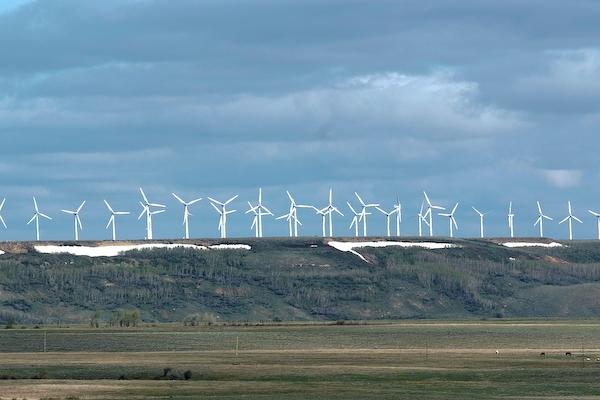
This summer, my Wife and I took a trip with her parents across the United States. As musicians for a wedding in Utah, we decided that a family driving trip across the country would be a somewhat cost and fun way to travel. I actually have never been west of Minneapolis/Davenport. As we were driving west on I-80, the rolling hills of Iowa greeted us with an enjoyable site.
This picture was taken on a long stretch of road outside Davenport. I thought the contrast was so very interesting.
Wind energy has taken hold as a growing resource for cities and towns that have ample air flow for much of the year. This form of technology is a great example of progress towards a more sustainable future.
The report finds that in 2011, roughly 6,800 megawatts (MW) of new wind
power capacity was added to the U.S. grid, a 31 percent increase from
2010 installations. The United States’ wind power capacity reached
47,000 MW by the end of 2011 and has since grown to 50,000 MW, enough
electricity to power 13 million homes annually or as many as in Nevada,
Colorado, Wisconsin, Virginia, Alabama, and Connecticut combined. The
country’s cumulative installed wind energy capacity grew 16 percent from
2010, and has increased more than18-fold since 2000. The report also
finds that six states now meet more than 10 percent of their total
electricity needs with wind power.
This is really good news! However, an article from Minnesota Public Radio written by Rob Reimer has this to say:
Rural dwellers are "asked" to host wind turbines and to pay for transmission lines to furnish city dwellers with green power from wind. Investors make huge profits while taxpayers and ratepayers get to pay 20 percent more for their power. So who is this technology benefiting? For exactly whom is it "free?" Financially, wind energy is a losing proposition for most everyone who does not directly profit from the manufacture, siting, servicing, removal, financing or taxing of turbines, or from the disbursal of the electricity produced by them.
The wind boon benefits the turbine industry, not the general public. The industry is a terrible waste of resources: Human, physical, financial, temporal and aesthetic. These finite resources could be better spent transforming the physical infrastructure of our society toward sustainable energy production and use, and toward creating jobs that benefit the entire society.
This brings up a tremendously good point. Though Wind turbines might be seen as a sustainable method of energy, the amount of work and capital that goes into making a turbine part of the electrical grid can sometimes do more harm than good. Also, storage for all that energy is at a premium. Something has to be done to help make the sustainable energy market perform on the economic scale.
Luckily,
So now we start to understand all the moving pieces in the puzzle. Energy is an important aspect of our society, but how can we create the infrastructure that is needed to produce enough of that energy while sustaining the planet? I think wind energy will prove very useful for communities who live in rural and suburban areas that have access to open fields and windy days. However, each region is slightly different. What might work in Illinois is not going to work for Colorado. Arizona has a much greater potential for Photovoltaics while areas on the West Coast might benefit from a Geothermal plant or ten. As a nation, we need to start developing these technologies to help all of us save our planet while preserving our energy.

 I called my mother-in-law to see if she was around to deliver me a jump. I decided it would be a good time for an observation! This time around the UWSP campus was covered with snow. I swear for the first four years of my schooling this place was nothing but snow. It certainly doesn't seem that way now.